
By Brett Grobarz, Vice President of Sales, Shepperd Construction
You opened the new reserve study, flipped to the cash flow table, and saw it: a roof replacement in year two, sealant and waterproofing work in year three, balcony repairs close behind, and a reserve balance nowhere near enough to cover it. The board wants answers. Owners will want explanations. And you are the one expected to have a plan. If the study points to envelope or common-area work, Shepperd’s HOA reconstruction services explain how a reconstruction contractor can support planning and delivery.
This guide is for Texas HOA and condo property managers and the boards they support. It covers what a reserve study is actually telling you, which numbers matter most, how to fund the gap, and how to turn a spreadsheet line item into a verified, buildable repair scope.
Quick answer: If a reserve study flags major repairs, confirm the study date and assumptions, address immediate safety concerns, verify current conditions and project scope, compare a project estimate with available funding, and confirm approval and notice requirements with association counsel.
What It Means When a Reserve Study Flags Major Repairs
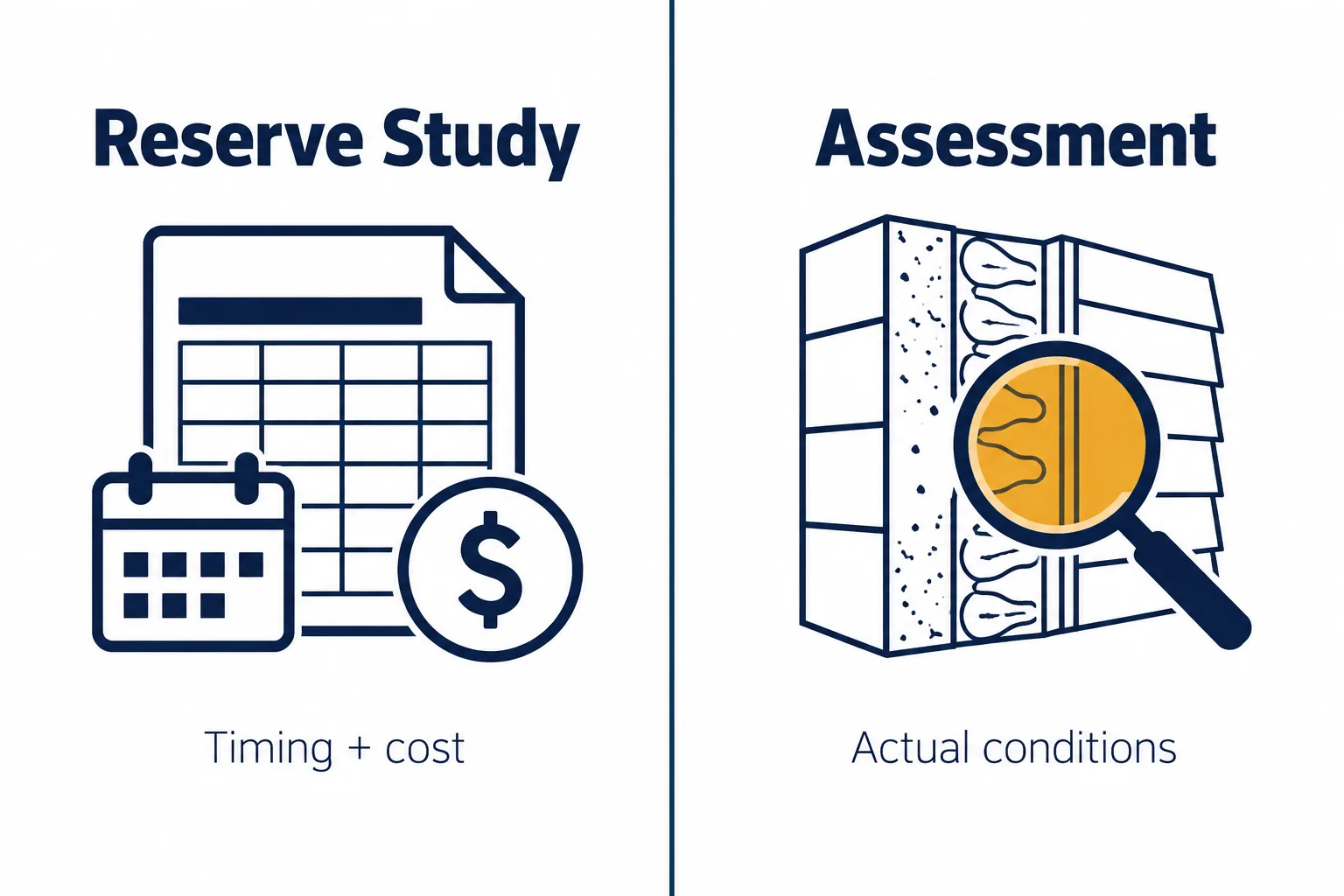
A reserve study that shows major repairs needed is a funding and planning signal, not an emergency diagnosis. It estimates when components will reach the end of their useful life and roughly what replacing them will cost. It does not confirm why a component is failing, how far damage has spread behind the surface, or exactly what the repair should include.
For Texas multifamily and condominium properties, major reserve items may include:
- Roofs and roof flashing
- Waterproofing, sealants, and expansion joints
- Windows and window perimeter seals
- Balconies, breezeways, and elevated walkways
- Exterior cladding (stucco, masonry, siding, EIFS)
- Parking structures and paving
My background spans architecture and construction, and the framing I have found most useful for boards is simple: the reserve study estimates timing and replacement cost. A building-envelope assessment or targeted testing can help investigate current conditions and inform a repair scope. Use the study for long-term planning and project-specific evaluation for current conditions before finalizing a major work plan.
What Does a Reserve Study Tell You?
A reserve study has two halves. Read them separately.
The physical analysis is the inventory. It lists each common-element component the association maintains, its observed condition, expected useful life, remaining useful life, and estimated replacement cost.
The financial analysis compares what you have saved with what you will need. It shows the current reserve balance, the association’s funding status, and a recommended contribution schedule, usually projected over a long horizon such as 30 years.
Studies also come in different depths. A full study typically includes a site inspection and builds the component inventory from scratch. Updates may include a site visit, or they may be desk reviews that adjust numbers without anyone walking the property. Check the cover pages, so you know which one you are holding.
Just as important is what a reserve study does not do. It is not a forensic investigation. It does not involve destructive testing, such as opening a wall to inspect sheathing or water-testing a window assembly. And it is not a cost-of-repair scope. Replacement costs in a reserve study are planning allowances, often based on unit pricing, not contractor pricing for your building’s actual conditions.
The Four Numbers to Read First
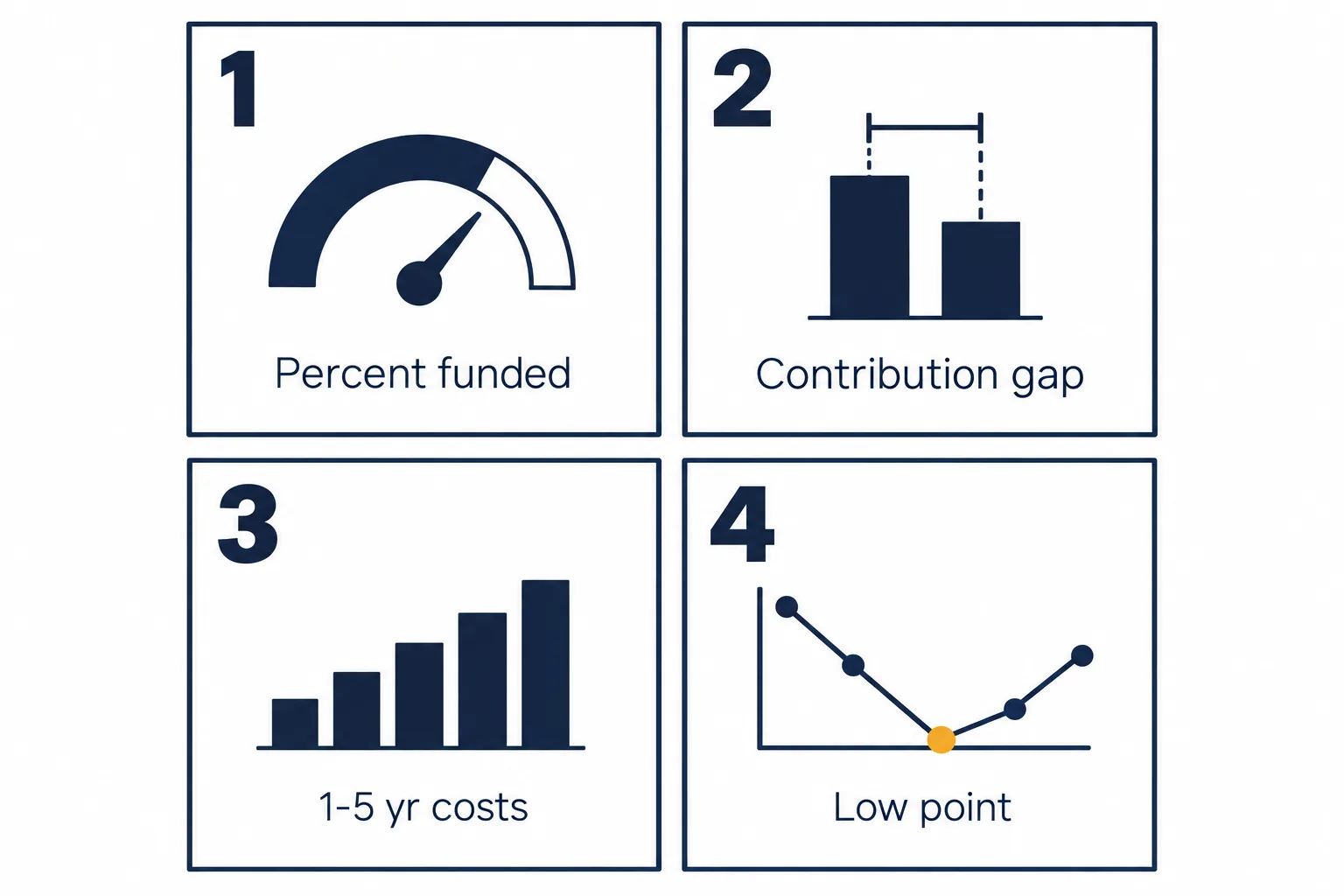
You do not need to read every page before the next board meeting. Start with these four.
1\. Percent funded. This compares the actual reserve balance with the fully funded balance, meaning what would be on hand if every component had been saved for in proportion to its age. Percent-funded thresholds are not a Texas legal standard, and provider labels differ. Read this number alongside the study’s assumptions, projected cash flow, near-term expenses, and funding plan; a low percentage alone does not determine whether or when a special assessment or loan is needed.
2\. Recommended annual contribution vs. current contribution. If the study recommends a contribution well above what the budget allocates now, that gap is the core of your funding conversation.
3\. Projected expenditures in the next one to five years. Identify which components account for the highest near-term costs, then prioritize those for condition and scope review.
4\. Lowest projected reserve balance. Scan the 30-year cash flow for the year the balance bottoms out. If it dips near or below zero, the plan as written depends on money the association does not have.
Why Components Fail Ahead of Schedule

Boards are often surprised when a component the last study gave ten more years suddenly appears as a near-term replacement. A few patterns explain most of these cases.
Deferred maintenance compounds. A failed sealant joint or cracked flashing detail can allow water to reach sheathing, framing, or other concealed materials. Visible interior staining may not show the full extent of moisture exposure, so investigate the assembly before deciding that surface repairs are sufficient. We break down how this escalates in our guide to the cost of full building reconstruction for HOAs and the risk of deferred maintenance.
Texas climate stress. Heat and UV exposure break down sealants and roofing. Heavy rain events test every flashing and window perimeter at once. Expansive clay soils in many parts of the state can cause movement that cracks cladding and opens joints. Hail can shorten a roof’s life in a single storm.
Possible design or installation concerns. A component may require evaluation before its expected replacement date. If the condition could involve a construction defect or a claim, coordinate with a forensic engineer and qualified counsel before invasive repairs, so they can advise on documentation and next steps. Shepperd can support investigative openings and cost-of-repair planning when engaged for that role.
Your Funding Options: Fee Increases, Special Assessments, and Loans
Once you know the size of the gap, the board has a handful of tools. Most associations use a combination.
Gradual dues increases. Raising regular assessments over several years is easier on owners and keeps the reserve plan on track, but it closes a large gap slowly. It works best when major work is still a few years out.
Special assessments. A special assessment raises money quickly, which matters when a roof or waterproofing failure cannot wait. It also draws the most pushback. Whether the board can levy one, and what notice, meeting, or owner-approval steps apply, depends on the governing documents and the law applicable to that association. Chapter 209 applies to many property owners’ associations but excludes condominiums; ask association counsel to confirm which rules apply. See the official Texas Property Code Chapter 209.
HOA loans or lines of credit. Financing spreads the cost so owners are not hit with one large bill, but it adds interest and typically requires board approval, sometimes owner approval too. Expect a lender to ask about the reserve study and the planned scope.
Phasing the work. Splitting a project into phases can match spending to cash flow. The risk is letting deterioration outrun the schedule. Phase by building or elevation only after you understand how active the water intrusion is, and put the highest-risk areas in the first phase.
Insurance. Insurance may help with sudden, accidental damage, such as a specific storm event, but policies typically exclude wear, age, and deferred maintenance. If a covered event is part of the picture, our article on how to maximize an HOA insurance payout for reconstruction explains why long-term reconstruction planning still matters when a claim is involved.
Texas Reserve Study Requirements and Resale Disclosures
This is not legal advice, and your association’s attorney should confirm what applies. Texas does not generally require associations to commission routine reserve studies or meet a statewide reserve-funding percentage; governing documents and lender or insurer requirements may still matter. Check the association’s governing documents and ask counsel about current obligations. This overview of Texas reserve study requirements discusses the absence of a general statutory study mandate; treat it as background and verify legal questions against the applicable statutes and your documents.
- Two chapters, two kinds of associations. Condominiums are generally governed by Chapter 82 of the Texas Property Code (the Uniform Condominium Act), while many single-family and townhome communities fall under Chapter 209.
- Resale certificates disclose reserve information under separate statutes. For condominiums, Texas Property Code §82.157 addresses reserve information in the resale certificate. For property owners’ associations, §207.003 addresses resale-certificate contents, including reserves, if any. The required information varies by association type; a disclosed balance does not by itself establish whether reserves are adequately funded.
- Your governing documents control the details. Limits on special assessments, voting thresholds, and notice periods usually live in the declaration and bylaws. Confirm them with association counsel before announcing anything.
Rules in other states do not automatically apply to a Texas association. Have counsel review the association type, governing documents, applicable Texas statutes, and any financing or insurance requirements.
A Step-by-Step Plan After a Reserve Study Flags Major Repairs
Use this sequence to move from planning estimates to a defined project scope and funding discussion.
Step 1: Confirm the study is current. Check the date and study type. If it was a desk update with no site visit, the condition ratings may be off, in either direction.
Step 2: Prioritize life-safety and water intrusion. Address immediate life-safety concerns first, with qualified professionals. Then assess active water intrusion and other conditions that may be worsening; concealed moisture can affect adjacent assemblies, but the extent and repair need must be established for each building.
Step 3: Verify actual condition with a building-envelope assessment or investigative testing. Before committing funds, find out what is happening behind the surface. Targeted openings, water testing, and moisture mapping may help clarify conditions and inform scope; the appropriate evaluation depends on the assembly and should be coordinated with the design professional or engineer.
Step 4: Replace allowances with a contractor-developed cost of repair. Reserve study pricing is a planning number. Compare the allowance with a project-specific cost estimate based on verified conditions, quantities, access, and sequencing. Use it to inform budgeting and owner discussions; it is an estimate, not a guaranteed final cost.
Step 5: Build a phased scope and funding plan, then communicate it. Match the verified scope to the funding tools above, set a realistic schedule, and present it to owners with the supporting data.
Step 6: Update the reserve study. Once scope and costs are verified, send the new numbers to your reserve provider so the next study reflects reality instead of carrying old allowances forward.
Repair or Reconstruct? Deciding the Scope
Not every flagged component needs full replacement. Targeted repairs can extend useful life when damage is localized, and the underlying system is sound. Resealing joints on a facade with intact substrate, for example, can buy meaningful time.
Repairs stop making sense when they only delay a larger reconstruction. Warning signs include:
- Leaks that return after each repair
- Hidden substrate damage, such as rotted sheathing or corroded framing, found during openings
- Flashing that has failed across an entire elevation rather than at one detail
- Structural concerns flagged by an engineer
This is where preconstruction services earn their keep. A contractor who prices both a repair option and a reconstruction option, with real quantities and a clear explanation of what each buys in remaining life, lets the board compare choices on numbers instead of guesses. Our framework for when repair is not enough and how to vet a reconstruction contractor walks through that decision in more detail.
Condo Roof Leaks and Water Damage: Who Is Responsible?
This question comes up almost every time a reserve study flags the roof. When there is condo water damage from a roof leak, owners want to know who pays.
In most associations, responsibility follows how the declaration defines common elements versus units. Roofs, exterior walls, and the building envelope are typically common elements, which usually makes the HOA responsible for repairing them. Interior finishes, improvements, and personal contents are often the owner’s responsibility, frequently through the owner’s own insurance. The exact line varies from one set of governing documents to the next, and insurance policies add their own terms.
So is the HOA responsible for water damage from a roof leak? Often it is responsible for the roof itself, while responsibility for interior damage depends on the documents and policies involved. Boards and owners should confirm with the governing documents, their insurers, and counsel rather than relying on general rules.
The practical lesson for property managers: when the reserve study flags a roof or waterproofing item, address it before it becomes a series of questions about who is responsible for water leaks inside individual units. A planned roof project is far less disruptive than a string of interior water claims.
How to Communicate a Funding Gap to Owners
Clear, timely information can help owners understand the reason for proposed work and the decisions ahead.
- Show the data. Share the percent funded figure, upcoming expenditures, and the projected low point in the cash flow. Plain charts beat dense tables.
- Explain the cost of waiting. Explain the risks of deferral using the building’s observed conditions, updated scope, and schedule. In some cases, delay can allow damage to expand or require more disruptive work; avoid assuming that outcome without project-specific evidence.
- Lead with verified scope and real pricing. Share the findings, assumptions, and estimate basis so owners can see how the proposed scope and budget were developed.
- Hold open meetings and publish a timeline. Tell owners when work starts, how long it will take, what access is needed, and how they will get updates.
How a Reconstruction Contractor Fits In
A reserve study gives you a list. Turning that list into finished work usually involves several professionals: the property manager coordinating the effort, a forensic engineer evaluating conditions and designing repairs where needed, association counsel guiding governance questions, and a reconstruction general contractor who can test, price, and build.
At Shepperd Construction, our role is the contractor seat at that table. We work alongside property managers, forensic engineers, and attorneys across Texas, helping gather field data through investigative testing and translating reserve study line items into a cost-of-repair scope the board can act on. From there, we perform building-envelope and waterproofing reconstruction, along with aging-infrastructure capital work and difficult-access projects. Our HOA reconstruction contractor guide outlines questions boards can use when evaluating contractor fit and scope.
Over more than eleven years of reconstruction work in Texas, one lesson has held up best: careful preconstruction, verified conditions, and clear communication help teams coordinate complex projects. That means preconstruction before pricing, verified conditions before scope, and clear, consistent communication with the board and owners from the first site walk to the final punch list.
Frequently asked questions
Are reserve studies required for Texas HOAs?
What does “percent funded” mean?
Does a reserve study confirm that a component is defective?
What should an HOA do if a major repair is missing from the study?
Can a reserve-study estimate be used as a construction bid?
Turn Your Reserve Study Into a Clear Repair Plan
A reserve study that flags major repairs is the start of a decision, not the end of one. The next step is finding out what is really happening in your building and what it will truly cost to fix.