
Is building envelope replacement CapEx or OpEx? It depends on what the work does, which unit of property is affected, who is evaluating it, and the records supporting the scope.
For federal income-tax purposes, a qualifying repair or routine maintenance may be deductible in the period incurred, while a major replacement, betterment, restoration, or adaptation generally points toward capitalization. That is a starting point, not a universal rule.
Your CPA or tax adviser makes the final tax determination.
The contractor’s scope is important evidence, but it does not determine the tax treatment on its own.
This article focuses on federal tax concepts and project documentation; the appropriate professionals should review book accounting, lease recovery, HOA funding, legal questions, and engineering conclusions.
Quick Answer: Is Building Envelope Replacement CapEx or OpEx?
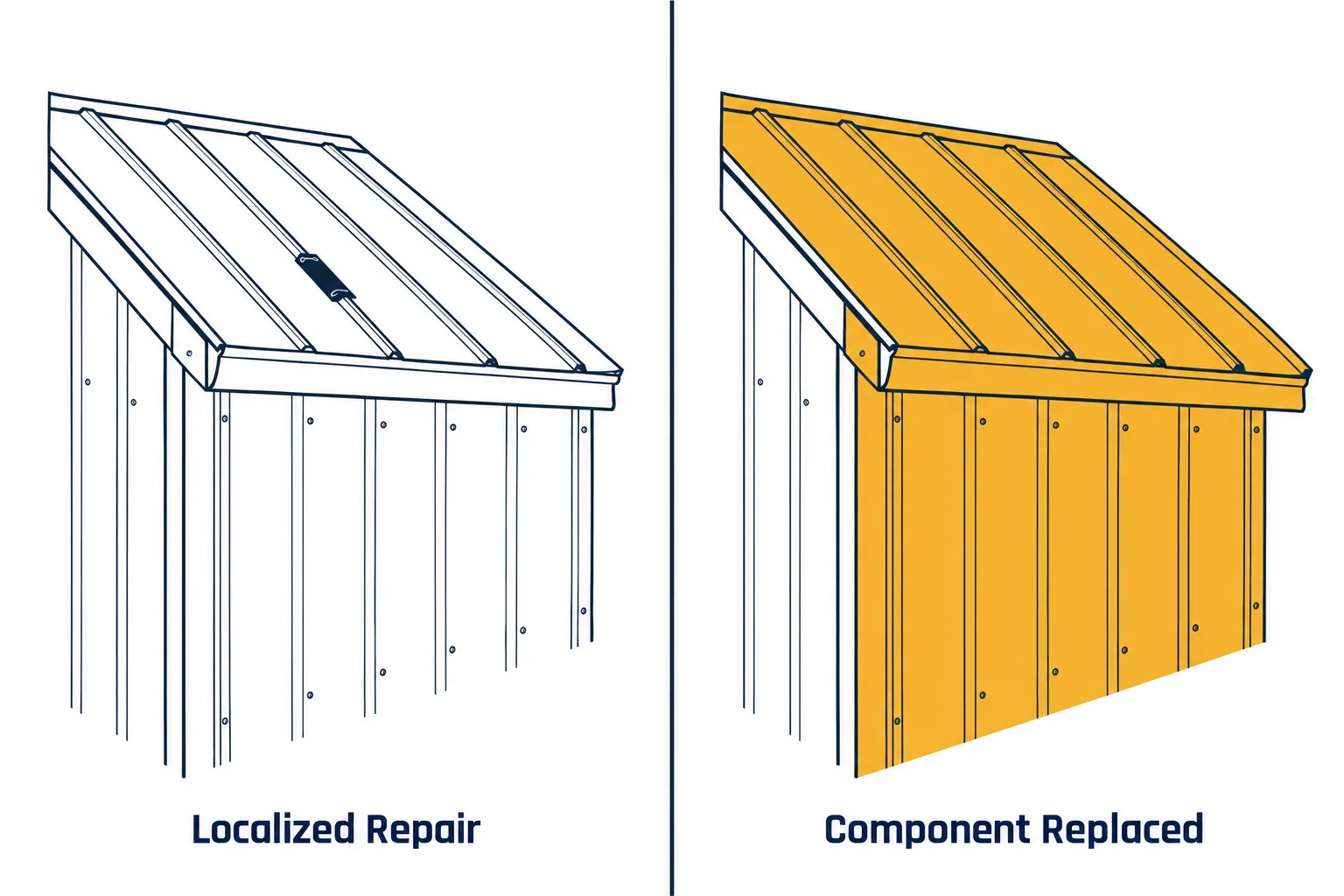
Use this as a planning screen, not a tax conclusion:
| Envelope work | Typical classification question | Why the distinction matters |
|---|---|---|
| Localized repair or routine maintenance | Does the work keep the existing system in its ordinary operating condition? | A qualifying repair may be treated as a current expense. |
| Replacement of a major component | Is a substantial roof, wall, window, or cladding component being replaced? | Component replacement often points toward capitalization, subject to the facts. |
| Betterment or adaptation | Does the project materially improve the asset or adapt it to a new use? | The added value or changed use may require capitalization. |
| Mixed envelope project | Can repair, replacement, testing, access, and upgrades be separated? | Clear line items give the owner and CPA a better record to review. |
A full roof or cladding replacement commonly requires a CapEx analysis, but “full replacement” is not a substitute for applying the applicable tax rules. A sealant renewal, isolated flashing repair, or localized patch may be analyzed differently.
CapEx vs. OpEx in Plain Terms for Envelope Work
For a business taxpayer, qualifying repair and maintenance costs may generally be deductible in the period incurred. Capital costs are generally added to the property’s tax basis and recovered over time under the applicable depreciation rules.
For an HOA or condominium association, the source of funding is a separate governance and budgeting question. A project may involve operating funds, replacement reserves, a capital assessment, or another funding source without that funding choice deciding the federal tax treatment.
The useful question is whether the work keeps the asset in the condition it was already in or materially improves, restores, replaces, or adapts it. The answer depends on the applicable rules and the project facts, not on a slogan such as “hold means expense” or “better means capitalize.”
CapEx, OpEx, reserves, and book accounting are not interchangeable
- Federal tax treatment: Asks whether the cost is currently deductible or must be capitalized under the applicable tax rules.
- Book accounting: May follow the owner’s accounting policy and financial-reporting framework.
- Lease or CAM recovery: May depend on the lease language and negotiated allocation of capital work.
- HOA reserve funding: Follows the declaration, reserve study, budget, assessments, and governing requirements.
A property manager, asset manager, HOA board, CPA, and contractor may therefore be looking at the same envelope project through different lenses. The project record should make those lenses easier to reconcile.
The Federal Tax Framework: Betterment, Restoration, and Adaptation

There is a defined federal framework, not just a general preference. Under the IRS tangible property final regulations, a unit of property is improved when amounts paid are for a betterment to the unit of property, to restore it, or to adapt it to a new or different use.
Applied to building envelopes:
- Betterment: Work that corrects a material defect, materially adds capacity or strength, or materially improves the quality of the existing system. A voluntary upgrade to a higher-performing roof or wall assembly may raise a betterment question.
- Restoration: Work that replaces a major component or substantial structural part, or brings a deteriorated or damaged assembly back to an operating condition. A tear-off and replacement of a major roof assembly may raise a restoration question.
- Adaptation: Work that adapts an existing building component to a new or different use. Changing an envelope system to serve a materially different building use may raise an adaptation question.
The contrast is practical but not automatic: recoating a serviceable roof or renewing sealants may be maintenance, while tear-off, substrate reconstruction, and a new assembly may involve capitalization. The CPA must apply the complete facts.
Why the Unit of Property Matters for Envelope Work

Owners sometimes reason that a roof or wall system is only one part of a much larger building, so replacing it must be a minor expense. The improvement analysis is not resolved simply by comparing the project price with the value of the entire property. The relevant unit of property and the specific work performed matter.
Roofing, exterior walls, windows, cladding, waterproofing, and related assemblies should be described precisely enough for the owner and CPA to evaluate what was repaired, what was replaced, and what was improved. A partial scope can be more difficult to classify than a clearly defined component replacement because the result may turn on the condition, extent, and function of the work.
Raise the question with the CPA before the contract is finalized, especially when the estimate combines localized repairs, component replacement, code-related work, voluntary upgrades, and interior restoration.
How Scope Documentation Affects the Classification
Mixed scopes are normal on aging Texas building envelopes. One mobilization may include sealant renewal at windows, moisture investigation, substrate repair, roof replacement, temporary protection, and interior restoration.
A segregated estimate cannot guarantee a tax result, but it gives the owner and CPA a usable record. Instead of one undifferentiated lump sum, ask whether the estimate can identify:
- investigative testing and documentation;
- localized repair or routine maintenance;
- replacement of a roof, wall, window, cladding, or waterproofing component;
- substrate or structural repair discovered during the work;
- code-related work and voluntary upgrades;
- access, staging, protection, and temporary measures; and
- interior restoration associated with the envelope work.
Moisture surveys, infrared scans, photographs, test cuts, and condition reports help establish what the project team observed and why the proposed scope was selected. They do not, by themselves, decide whether a cost is CapEx or OpEx.
For owners planning a commercial envelope project, commercial building reconstruction services can be connected to the preconstruction record, estimate structure, phasing plan, and repair scope.
Tax, Book, Lease, and Reserve Treatment Are Separate Questions
The same project can produce several different accounting conversations:
- The CPA analyzes federal tax treatment.
- The owner’s accounting team records the work under its book policy.
- A lease may determine whether capital work is recoverable from occupants and how it is allocated.
- An HOA board determines how the work is funded under its governing documents and reserve plan.
Do not use “we paid for it from reserves” as proof that a cost is CapEx for federal tax purposes, or use a tax conclusion as proof that the HOA’s governing documents permit a particular assessment. Keep the tax, accounting, lease, and governance questions coordinated but distinct.
Safe Harbors and Elections That May Affect the Result
The IRS provides elective provisions that may affect the treatment of qualifying costs, including the de minimis safe harbor, routine maintenance safe harbor, and small-taxpayer provisions. Eligibility, elections, accounting methods, and documentation requirements apply.
Do not treat a dollar threshold as an automatic repair rule. Thresholds and eligibility conditions can change, and the right analysis may depend on the taxpayer, the property, the accounting method, and the timing of the work. Confirm current requirements with the CPA rather than relying on a number in an old article.
What the project team can control is the record: a written maintenance history, defined service intervals, photographs, testing results, and invoices or estimates broken into meaningful line items.
Partial Disposition and Recovery Periods: Questions for Your CPA
Partial disposition. When an existing roof or cladding assembly is removed, the owner may need to ask whether a partial disposition election is available for the remaining undepreciated basis. IRS practice guidance on partial disposition discusses the records and depreciation facts that affect that analysis. It is not an automatic result of replacing a component.
Recovery period. A capitalized envelope cost may be recovered over a period that depends on the property and asset classification. IRS Publication 946 provides depreciation guidance, but the correct recovery period should be confirmed for the owner’s property, placed-in-service facts, and applicable tax rules.
These questions are easier to evaluate when tear-off, substrate repair, new assembly, access, testing, and ancillary interior work are visible as separate costs rather than hidden in one line item.
HOA and Condo Boards: Reserves, Assessments, and Governing Documents
Reserve funding and tax treatment are different decisions. Routine maintenance may be planned through the operating budget, while a major component replacement may be included in the reserve study or funded through a special assessment. The declaration, reserve study, board process, and applicable law control the association’s decision.
For condominium regimes governed by Chapter 82, Texas Property Code Section 82.107 addresses association responsibility for maintenance, repair, and replacement of common elements, subject to the declaration and the statutory provisions. Owners should review the governing documents before assigning responsibility for a roof, facade, balcony, window, or interior finish.
For a roof-planning discussion, see when a condo building roof may need full replacement. For association-specific planning, HOA reconstruction services and a full-building reconstruction cost discussion for HOAs may help frame the project conversation. Neither page replaces the board’s governing documents, reserve study, CPA advice, or legal advice.
Deferred Maintenance, Construction Defects, and Recovery Claims
A building owner may be responding to aging materials, a possible design or construction deficiency, or both. The reason for the work and the tax treatment of the work are separate questions. The treatment of any insurance, warranty, settlement, or other recovery is separate again.
Investigative testing and cost-of-repair documentation can support the budgeting file and the engineering record. Shepperd’s role is the contractor side: documenting observed conditions, coordinating with forensic engineers and project stakeholders, and developing repair scopes and cost information. Shepperd does not provide tax, legal, or engineering conclusions.
When an owner is deciding whether a repair is sufficient or a larger reconstruction is needed, and when repair is not enough for a commercial building, provide related project context.
What Owners Should Confirm Before Awarding Envelope Work
Before the scope and budget are locked, bring these questions to the owner, contractor, engineer, property manager, and CPA as appropriate. Property managers can also review how to manage a reconstruction project when coordinating occupants, records, schedules, and stakeholders.
- Define the unit of property and the specific envelope system affected.
- Document the existing condition with photographs, testing, reports, and repair history.
- Separate localized repair, major component replacement, substrate repair, code-related work, and voluntary upgrades.
- Identify access, staging, temporary protection, testing, and interior restoration costs.
- Ask the CPA whether current-expense treatment, a safe harbor, a partial disposition election, or another tax treatment may apply.
- Align construction phasing with the fiscal calendar, reserve funding, lease obligations, and board approvals.
This checklist does not classify the work. It helps the project team create the information needed for the professionals who will.
Frequently Asked Questions
Related readingSenior Living Center Reconstruction Contractors in TexasRead the guide →Frequently asked questions
Is building envelope replacement CapEx or OpEx?
Is a full roof replacement CapEx or OpEx?
Are window, cladding, and exterior-wall replacements treated like roof work?
Does an HOA roof project come from dues or reserves?
Do access, testing, and temporary-protection costs become CapEx?
Can a construction-defect project still be treated as CapEx?
What documents should a contractor provide before classification?
Talk Through Your Envelope Scope Before You Budget It
If you are planning commercial, multifamily, HOA, or other building-envelope reconstruction in Texas, contact Shepperd Construction before the scope and budget are locked. The discussion can focus on observed conditions, testing, access, line-item scope, phasing, communication, and coordination with your project professionals.
This article is general information, not tax, accounting, legal, or engineering advice.
Written by Brett Grobarz, Vice President of Sales at Shepperd Construction, who brings more than 16 years of experience across the construction, development, and building-envelope industries and holds a Master’s Degree in Architecture.