
A reroute during a roof replacement floods the units below. A building envelope fails and an HOA is staring down a six-figure repair. In moments like those, the line between a fixable problem and a lasting liability comes down to the contractor you hired, and whether you checked them before you signed. This guide walks through how to confirm a Texas contractor is legitimate, properly insured, and actually capable of the work.
Start with the Texas reality that trips up most people: the state does not license general contractors. “Verified” isn’t a single database hit here, it’s several checks stacked together.
What “Licensed” Actually Means in Texas (and What It Doesn’t)
There is no statewide general-contractor license in Texas. Anyone can call themselves a GC. What is licensed are specific trades, electrical, plumbing, HVAC, and others, regulated by the Texas Department of Licensing and Regulation. So when someone says they’re “licensed,” the real question is licensed for what.
For reconstruction, that means verifying the trade licenses your project requires, then confirming insurance, bonding, and a real track record on top of them. The license lookup is one input, not the whole answer. Treating it as the whole answer is how owners and property managers get burned.
How to Run a TDLR License Lookup (Step by Step)
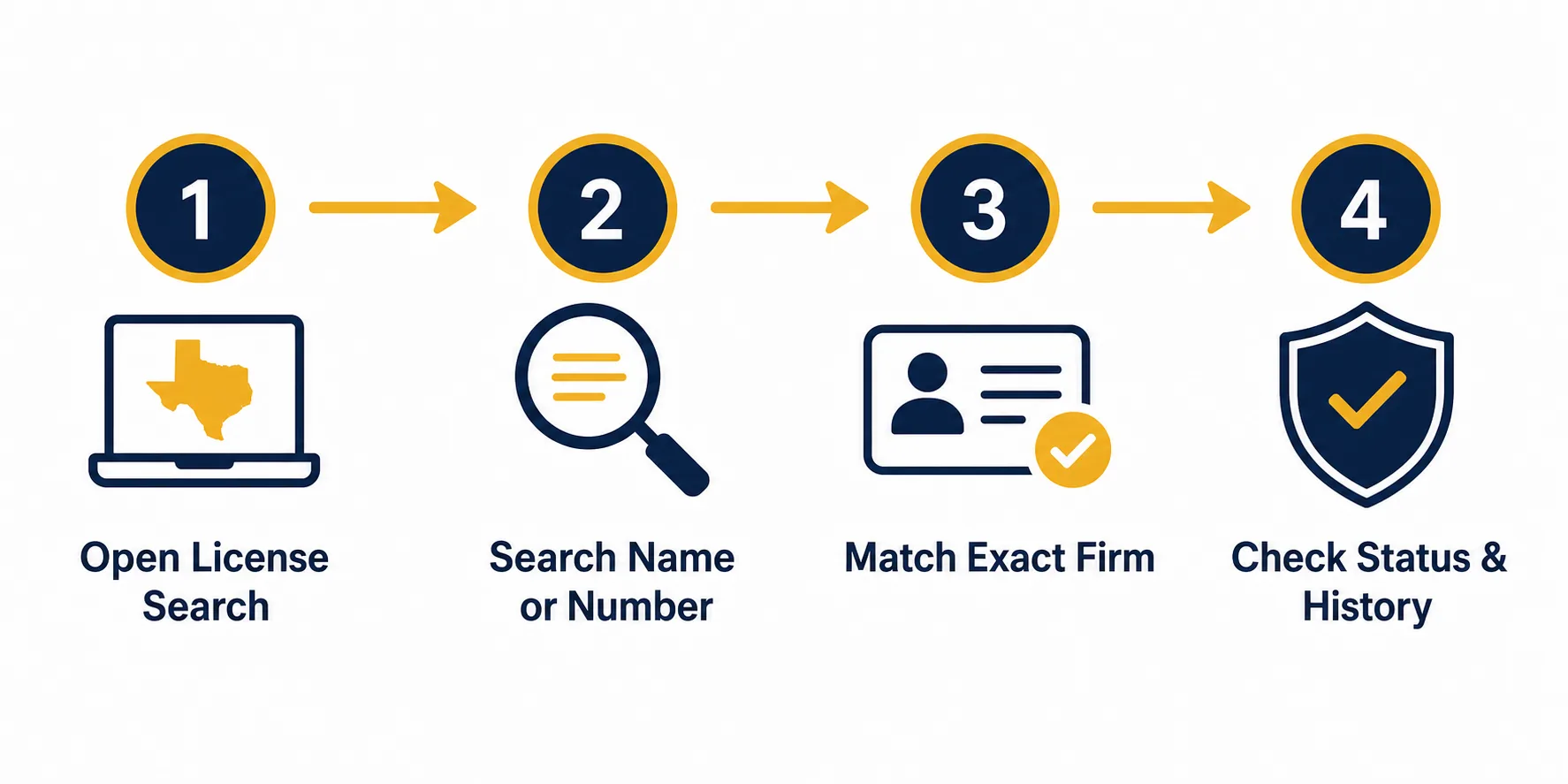
If your project involves a licensed trade, checking status takes a few minutes:
- Go to the Texas Department of Licensing and Regulation website.
- Open License Search. Search by name (a TDLR license status by name lookup) or by license number if the contractor gave you one.
- Match the name and number to the exact person or company you’re dealing with, not a similarly named business.
- Review the record: license status, expiration date, and any enforcement or disciplinary history.
Reading the Results
An active status means the license is current. Expired or inactive means it isn’t, and work performed on it may not be valid. Check the expiration date against your project timeline, a license that lapses mid-project is a problem. Then look at enforcement actions. A clean record isn’t a guarantee, but a history of complaints or penalties is a signal worth taking seriously.
Verifying City Permits and Local Registration
Many Texas cities require contractor registration and permits even for work the state doesn’t license at the trade level. Confirm the firm registers where your project sits and, this matters, that it pulls permits in its own name, not yours. A contractor who asks the owner to pull the permit is often sidestepping accountability for code compliance and inspections.
How to Verify Insurance (the Step People Skip)
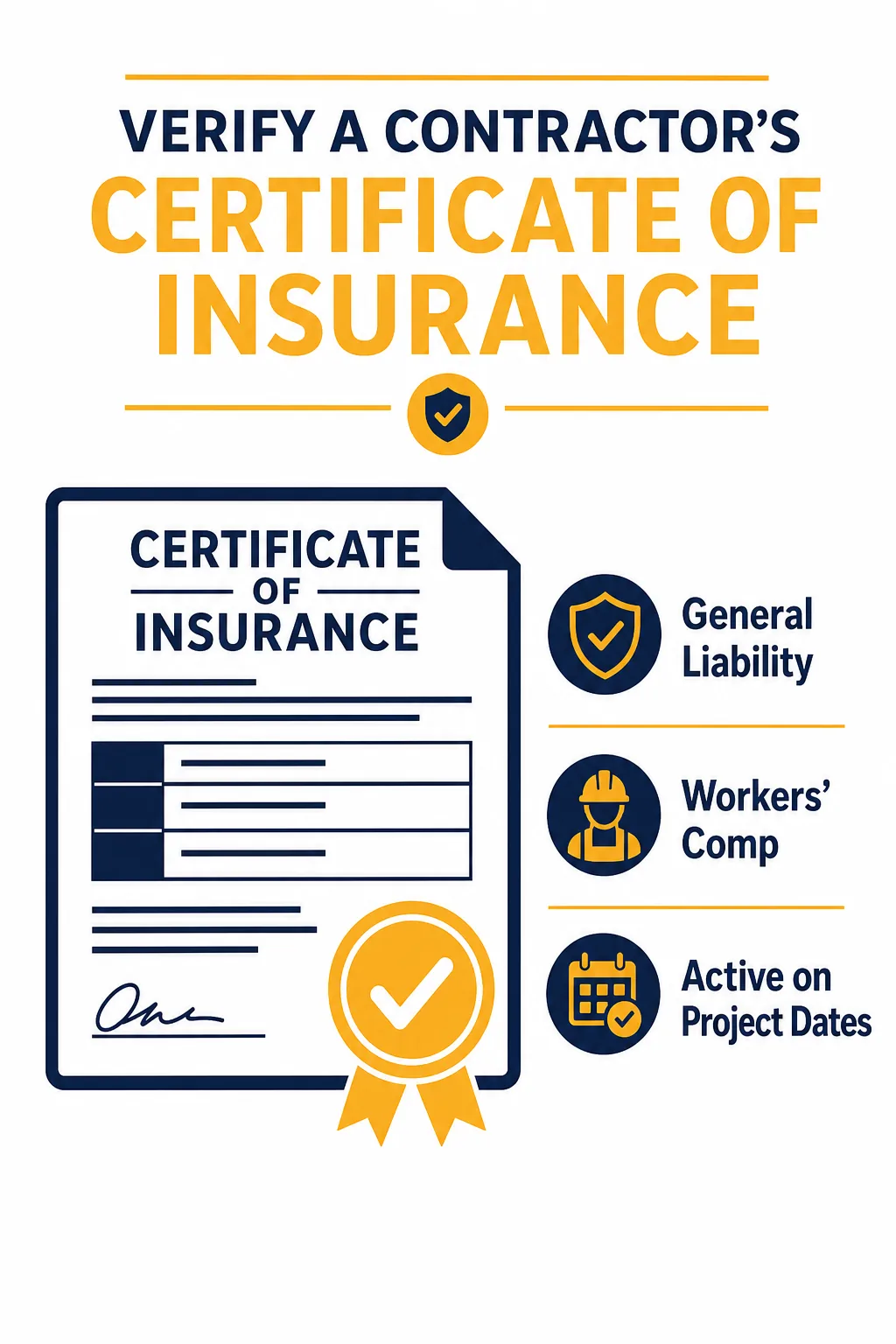
License checks get most of the attention; insurance verification is where people cut corners. Ask for a Certificate of Insurance (COI), then verify it directly with the carrier or listed agent instead of accepting a PDF at face value. Fake and expired certificates are a known contractor-scam tactic, which is why the Texas Department of Insurance urges homeowners to confirm coverage independently and watch for altered documents. Confirm the policy covers general liability and workers’ compensation, and that it’s active on your project’s dates.
A policy sized for a single-family bathroom won’t stretch to cover a multi-unit water loss.
Insurance Limits That Actually Matter for a Large or Multifamily Job
On a large or multifamily project, ask about coverage limits, whether you (or the association) can be added as an additional insured, and how the policy responds to a wide-area loss. The point isn’t a specific dollar figure, it’s coverage proportional to what could actually go wrong on your building.
Bonding and Why It Matters on Capital Projects
On capital-improvement and larger reconstruction jobs, bonding adds a layer of financial recourse if work is left incomplete or defective. It isn’t required on every project, but on a significant capex spend it’s worth asking about and confirming.
Red Flags That a Contractor Isn’t Who They Claim to Be
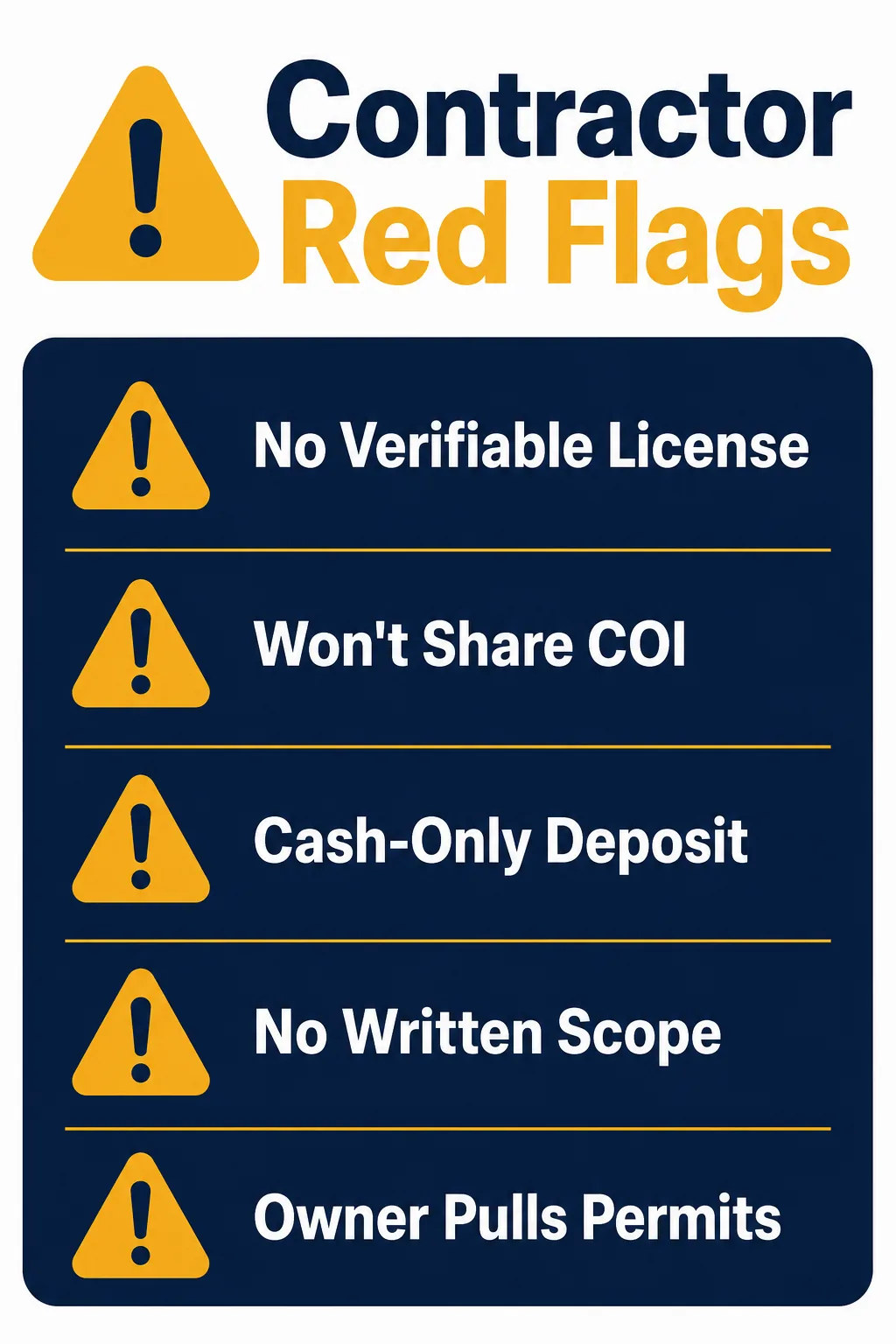
Watch for these, several of which the Texas Department of Insurance echoes in its consumer guidance:
- No verifiable license for a trade the job clearly requires
- Reluctance or excuses when you ask for a COI
- Cash-only terms or an unusually large upfront deposit
- No physical Texas address or business presence
- High-pressure tactics or “sign today” urgency
- No written scope of work
- Expecting you, the owner, to pull the permits
On a major reconstruction, any one of these should stop the conversation until it’s resolved.
Verifying a Reconstruction Contractor Is Different From Vetting a Handyman
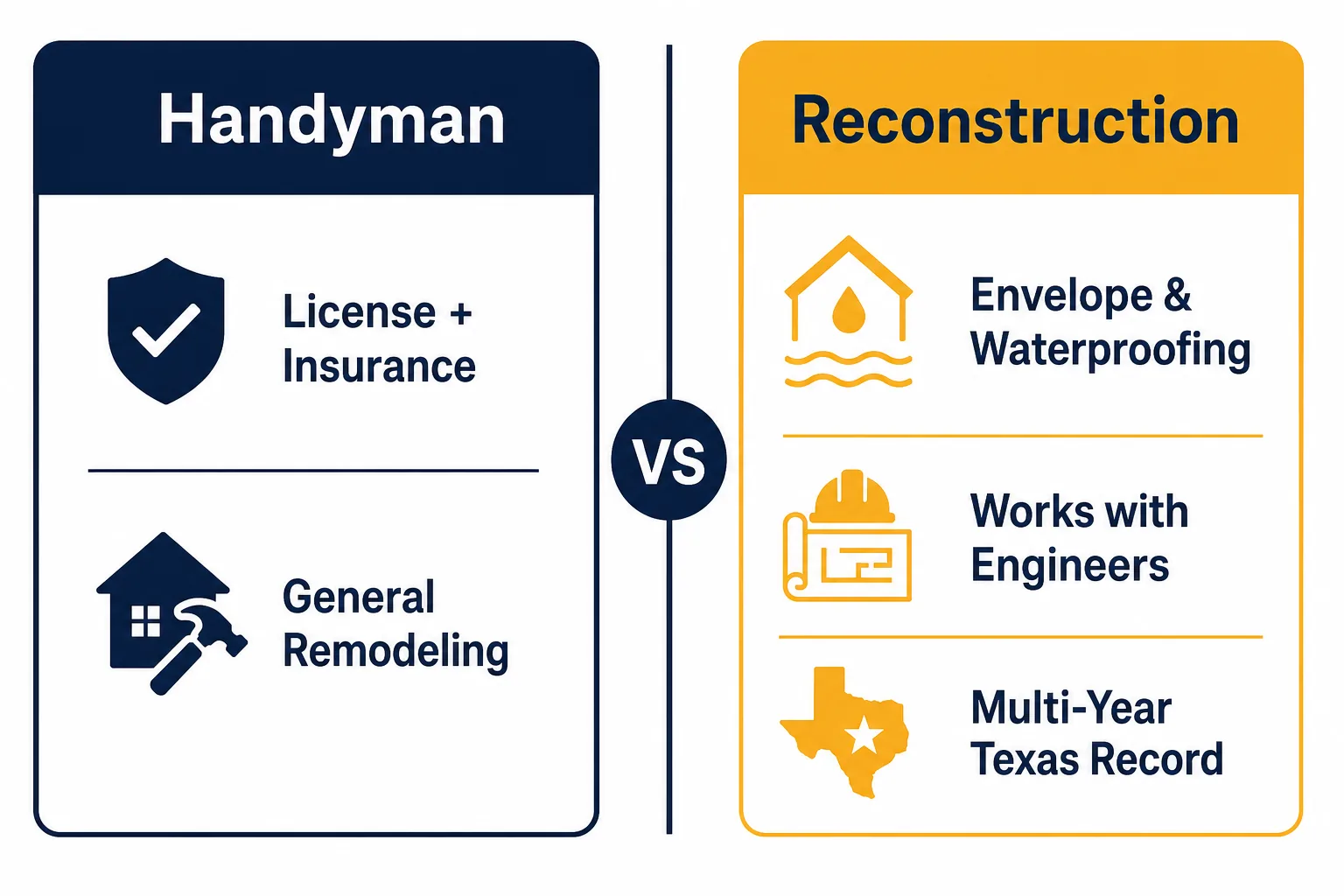
For building-envelope reconstruction, capex and aging-infrastructure work, or multifamily defect repair, the bar sits higher than license-plus-insurance. Before you commit, confirm the firm has:
- Demonstrated building-envelope, waterproofing, and structural experience, not general remodeling, but the specific work of stopping water intrusion and rebuilding the systems that failed.
- The ability to coordinate with forensic engineers and meet engineering and permit requirements. Reconstruction is documentation-heavy, and the contractor has to work inside that process, not around it.
- A verifiable multi-year Texas track record. Our own eleven-plus years rebuilding envelopes and repairing defects across the state is the kind of history worth asking any firm to prove, references, comparable projects, and results.
- Capacity for difficult-access and large capex work, so scale and site complexity don’t become mid-project surprises.
This is where a database lookup runs out of road. If you’re weighing firms for a significant job, our guide on how to choose a reconstruction contractor for large projects covers what to compare beyond credentials, and you can see the scope of our building envelope reconstruction across Texas to gauge fit.
Who’s Responsible When a Condo or Apartment Roof Leaks?
This is the question behind many of these searches, and the honest answer is that it depends on the governing documents and the cause. A few general principles:
- Roofs and building exteriors are usually common elements, which often puts responsibility for the structure itself on the HOA or association. Whether the association also covers interior damage depends on the CC&Rs and the split between the master policy and unit-owner policies.
- Ordinary wear-and-tear leaks are handled differently than water intrusion caused by a contractor’s work, say, a reroute or reroof that floods the units below. If a repair caused the damage, document everything and get the source and cause assessed rather than assuming.
- The most reliable path forward is a reconstruction contractor who works alongside forensic engineers to document the source, extent, and cause of the damage. That documentation protects owners and associations however responsibility ultimately shakes out.
For specifics on your CC&Rs, insurance split, or any dispute, talk to your association’s counsel, this is educational guidance, not legal advice.
A Practical Verification Checklist (Before You Sign)
- Trade license verified on TDLR (active status, current expiration, clean enforcement)
- City permit and registration confirmed, pulled in the contractor’s name
- COI verified directly with the carrier or agent
- Coverage limits sized to the project, additional-insured status where appropriate
- Bonding confirmed where the capital project warrants it
- References and a verifiable multi-year track record
- A written scope of work and clarity on who pulls permits
- Engineering and documentation capability for defect or envelope work
For a sense of how this plays out on real jobs, our reconstruction contractors in Austin, TX page shows how local permitting and coverage factor into project planning.
Frequently asked questions
How do I check if a contractor is licensed and insured in Texas?
How do I verify a company is licensed and insured?
Does an HOA cover roof leaks?
Who’s responsible for a leak in a condo or apartment ceiling?
What should I do if a contractor’s reroof caused a flood in my condo?
Do I need a licensed GC for a multifamily reconstruction in Texas?
Rebuild With a Firm Owners and Engineers Trust
Verifying a contractor protects your building; hiring the right one rebuilds it correctly. For more than eleven years, property managers, building owners, and forensic engineers across Texas have relied on us for building-envelope reconstruction and multifamily defect and water-intrusion repair, work that rewards care, quality, and hard-won knowledge over shortcuts. When your project can’t afford a wrong hire, talk to our reconstruction team and get a response within 24 hours.