
An HOA should define the failure, decide whether it needs engineering judgment, verify the professional engineer’s Texas license and firm registration, compare written scopes, and confirm how testing, reporting, access, and follow-up repairs will be handled. We can support investigative testing and reconstruction coordination; the forensic engineer remains responsible for engineering analysis and technical conclusions.
When an HOA has repeat leaks, unexplained cracking, or a building-envelope problem that routine repairs have not resolved, the board may need more than another contractor visit. A qualified Texas-licensed professional engineer with relevant forensic experience can investigate the observed conditions, define testing needs, document findings, and recommend next steps.
This guide explains when an HOA should hire a forensic engineer, how to compare qualifications and proposals, what the investigation may involve, and how the board can move from technical findings to a practical repair plan.
What Does a Forensic Engineer Do for an HOA in Texas?
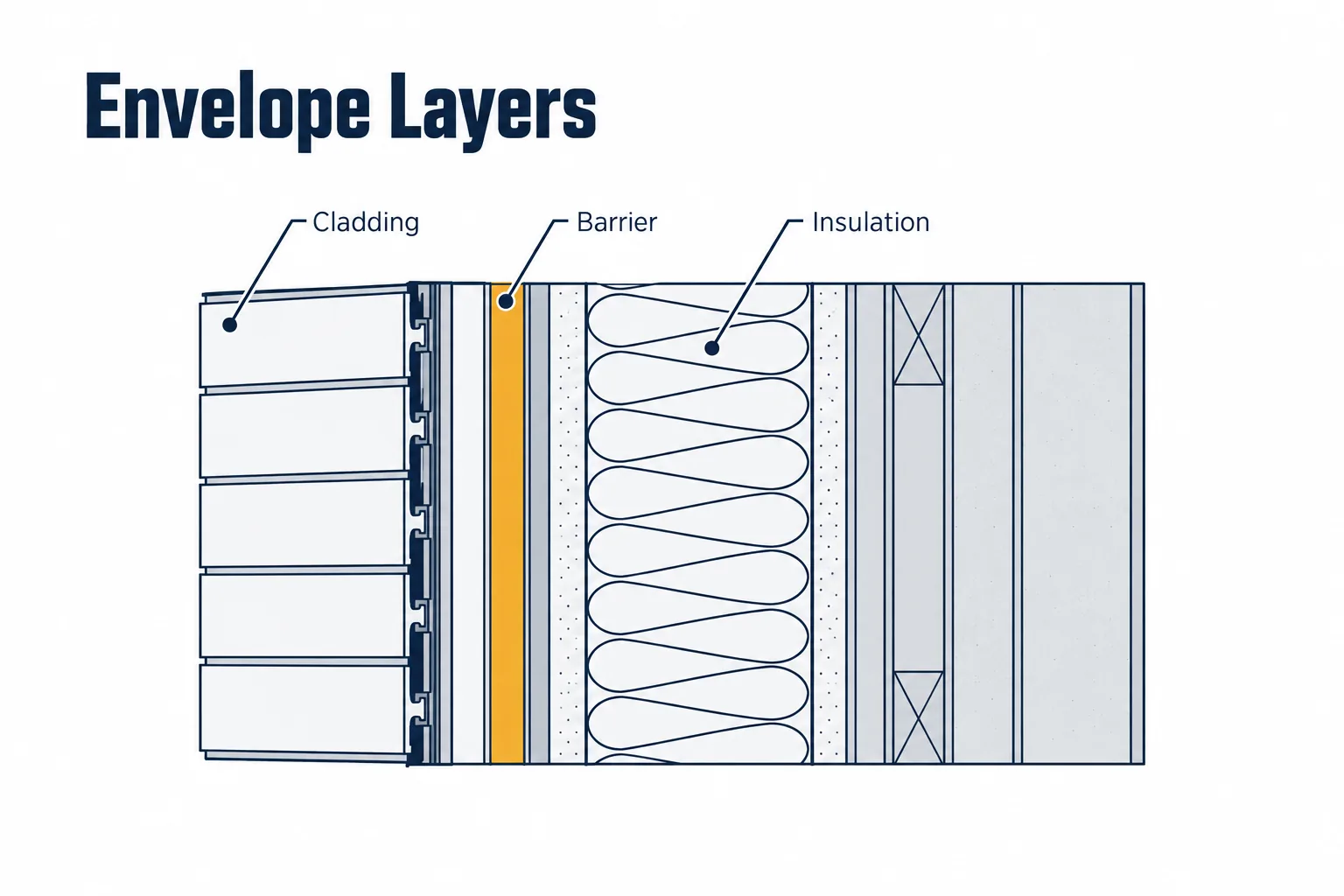
Forensic engineering applies engineering methods to investigate failures, damage, and suspected defects in an existing structure. Depending on the assignment, the engineer may review records, inspect observed conditions, recommend or direct testing, analyze evidence, and prepare technical findings about cause, extent, and repair implications. The work is retrospective: it helps the board understand what happened, what remains unresolved, and what information is needed before a repair decision.
Boards also need to distinguish the investigation from the construction work that may follow:
| Professional | Primary role | When an HOA may need one |
|---|---|---|
| Forensic engineer | Investigates an existing failure, damage pattern, or suspected defect and prepares technical findings. | The cause is unclear, disputed, recurring, or potentially building-wide. |
| Structural engineer | Evaluates load-bearing systems such as foundations, framing, balconies, and structural walls. | The concern involves movement, cracking, deflection, settlement, or structural distress. |
| Building-envelope or waterproofing specialist | Evaluates roofs, walls, windows, cladding, sealants, and water-management details. | The issue involves water intrusion or exterior-system failure. |
| General contractor | Provides access, selective demolition, temporary protection, repair pricing, and construction under an approved scope. | The board needs testing support or execution after the investigation defines the work. |
Typical HOA assignments include chronic water intrusion, balcony and deck framing, stucco and cladding failure, window and door assembly leakage, foundation movement, roof system failure, and post-storm damage where the scope is disputed.
Depending on the agreed scope, deliverables may include documented findings, photographs, records of what was tested and how, limitations, repair recommendations, and cost information the association can use for planning.
Our role is on the construction side of that process. We can support access planning, selective demolition, documentation, temporary weather protection, restoration of test locations, and reconstruction when those services are included in the approved scope. The forensic engineer remains responsible for engineering analysis and technical conclusions.
When Should an HOA Hire a Forensic Engineer?
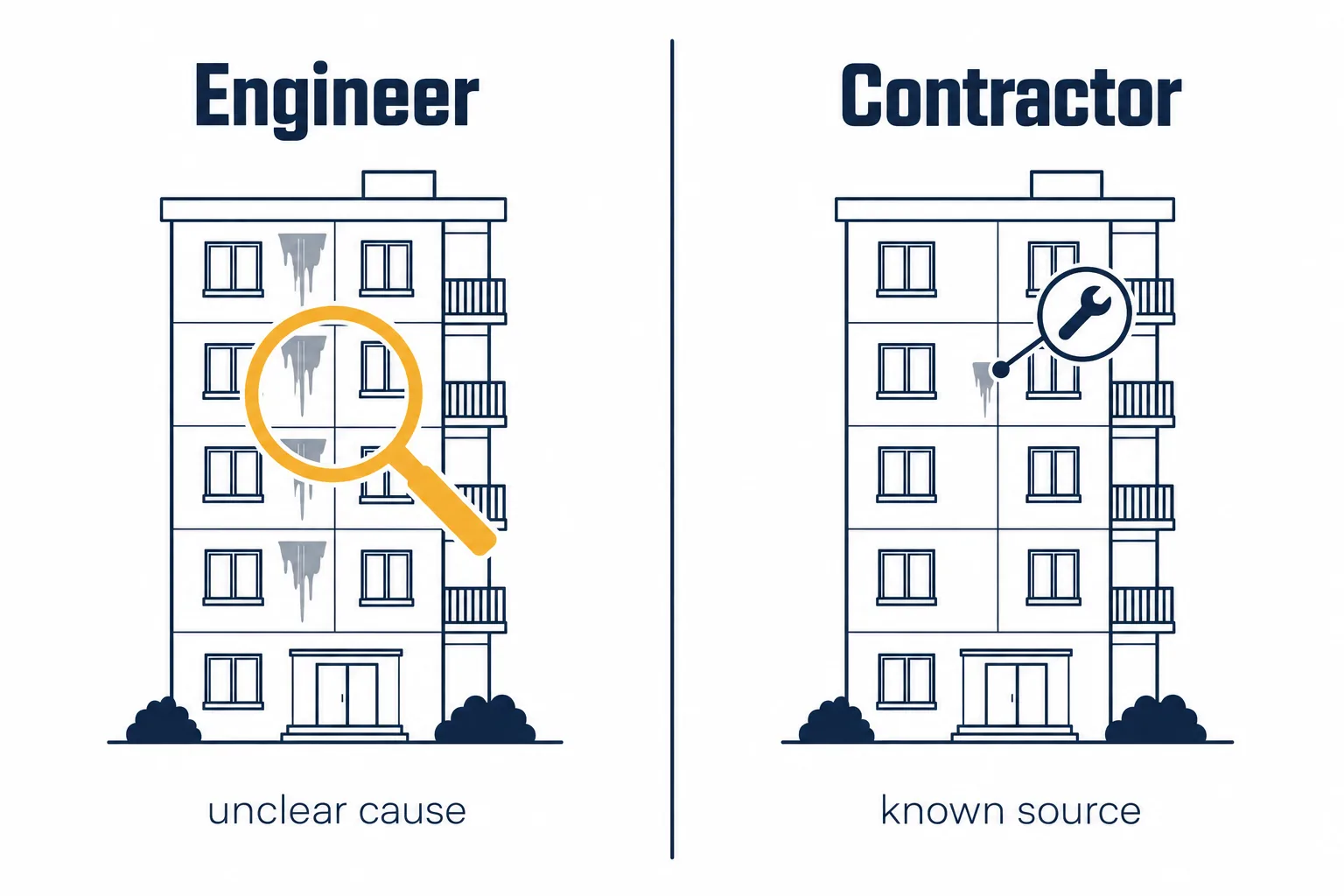
Consider a forensic engineer when one or more of these conditions apply:
- A leak returns after repair, or the source remains unclear despite reasonable maintenance efforts
- There is a leak in a condo ceiling or wall, and the source is not visually obvious, particularly when the water path crosses the line between a unit and a common element.
- Damage patterns look building-wide rather than unit-specific: stains at multiple stacks, efflorescence along one elevation, sealant failure in the same detail across many openings.
- You see cracking, deflection, sloping balconies or walkways, or any movement that could be structural.
- Cause and scope are disputed after a storm.
- The board is about to commit reserves or levy a special assessment for a large envelope project or a condo roof replacement.
A contractor may be appropriate when the problem is small, traceable, and within a routine repair scope, for example, a failed pipe fitting under a sink, one cracked tile at a shower pan, or a torn shingle after high wind. If the source is uncertain, the condition is recurring, or concealed damage may be involved, ask whether engineering investigation should come first.
Step 1: Define the Question Before You Call Anyone
Boards get vague reports because they ask vague questions. “Please look at our building” produces a walk-and-talk and an invoice.
Write a one-paragraph problem statement before you contact anyone: what is failing, where, when it started, and what has already been tried. Three sentences of specificity change the proposals you receive.
Then decide the purpose of the investigation, because it drives scope:
- Maintenance planning and prioritization
- Insurance claim support
- Reserve study accuracy and budgeting
- Evaluation of suspected construction defects
Gather documents first: original construction drawings and specifications, prior repair invoices, warranty documents, the current reserve study, earlier consultant reports, and the unit-owner complaint log. A dated log with locations, weather conditions, and prior responses can help an investigator compare patterns before opening an assembly.
Clarify the governing-document question early: which components are common elements the association maintains, and which belong to the unit owner? You do not need the final answer yet, but you need to know which sections of the declaration the investigation will touch.
Step 2: Verify Texas Licensure, Firm Registration, and Relevant Experience
Ask for the license number of the professional engineer responsible for the engineering work and verify it through the Texas Board of Professional Engineers and Land Surveyors license-verification resource. If the firm offers engineering services to the public in Texas, confirm its engineering-firm registration as well.
Then match the discipline to the failure:
- Structural for framing, balconies, walkways, and foundations
- Building envelope and waterproofing for water intrusion through walls, windows, and transitions
- Roofing systems for membrane and steep-slope assemblies
- Civil for site drainage and grading that pushes water back toward the buildings
Forensic engineering is not one uniform discipline. A highly qualified structural engineer is not automatically the right choice for a stucco wall that leaks only during driven rain.
Ask how many multifamily or condominium properties the engineer has personally investigated, and ask for examples related to the failure you are seeing. Professional liability coverage may be part of the association’s procurement requirements; request evidence if your policy or counsel requires it. It is not a Texas licensing requirement; the Texas Board’s enforcement FAQ distinguishes insurance from licensing requirements.
Step 3: Vet Candidates With the Right Questions
Interview two or three firms. Ask each of them:
- Can we see two or three redacted sample reports from buildings similar to ours? A report you cannot follow as a non-engineer is a report your owners may struggle to understand at an annual meeting.
- What testing methods do you use, and which recognized standards guide water-intrusion evaluations? Ask what standards and protocols inform the investigation. ASTM E2128 guidance for evaluating water leakage in building walls is one potentially relevant reference; the applicable methods depend on the building assembly, observed conditions, and agreed scope.
- Do you perform destructive testing yourselves, or coordinate a contractor to open the assembly? Either answer can be fine. You need to know who is responsible and who is insured for the opening.
- Who actually attends the site? The sealing engineer, or a junior technician with a camera?
- Will you provide a scope-limited proposal with a defined number of test locations, rather than an open-ended hourly engagement?
- How do you handle board presentations and homeowner Q&A? Owners vote on assessments, so the findings need to be explained in plain English.
Red flags include no written scope, reluctance to share any sample work, a confident cause determination offered before the proposed testing, or unclear separation between the investigation and any repair recommendation.
What to Request in a Forensic Engineering Proposal
A proposal should make the assignment understandable before the board approves it. Ask the firm to address the following items:
| Proposal item | What the board should confirm |
|---|---|
| Engineer and firm | Professional credentials, engineering-firm registration where applicable, discipline, and relevant HOA or multifamily experience |
| Assignment question | The specific failure, damage pattern, or concern the investigation will address |
| Records review | Drawings, specifications, repair records, complaints, warranties, reserve information, and prior reports |
| Field investigation | Inspection areas, moisture mapping, testing methods, number and type of test openings, and sampling assumptions |
| Deliverables | Report format, photographs, findings, limitations, repair recommendations, and cost information |
| Access and safety | Unit access, balconies, elevations, selective demolition, fall protection, temporary protection, and restoration |
| Fees and additional services | Fixed-scope items, hourly components, additional-service triggers, and the authorization process |
| Independence | Potential conflicts involving contractors, insurers, manufacturers, prior work, or other parties |
Compare proposals only after confirming that the scopes are comparable. A lower fee may reflect fewer test locations, less documentation, narrower deliverables, or different assumptions about access and restoration.
Step 4: Understand the Investigation Process and Investigative Testing
A credible investigation generally runs in three phases.
Phase 1: Document review and visual survey. Drawings, maintenance history, and complaint records, followed by a walk of the property, interviews with affected owners and on-site staff, and moisture mapping with meters and, where useful, infrared.
Phase 2: Investigative testing. This is where opinions become findings. It usually means controlled water testing at selected locations and opening a limited number of wall, roof, deck, or window assemblies to see the concealed condition.
A visual review can document symptoms, but concealed conditions may remain unresolved without appropriate testing.
We support engineers with access planning, selective demolition, documentation, temporary weather protection, and restoration of test locations when those services are included in the approved scope. Our investigative testing and HOA reconstruction services are construction support; the engineer remains responsible for engineering analysis and technical conclusions.
Plan difficult-access conditions before testing, not during it. High elevations, occupied balconies, courtyards with no equipment path, swing-stage access, or rope access can affect schedule, cost, and resident disruption. Those conditions belong in the scope while the scope is still being written.
Phase 3: Report and recommendations. Depending on the scope, the deliverable may identify observed conditions, testing performed, limitations, repair recommendations, and cost information for board planning.
Step 5: Get the Engagement and Board Approval Right
Confirm who the client is. In almost every case it is the association, acting through the board, with the management company coordinating access and communication. Write that into the agreement so there is no ambiguity about who receives the report.
The engagement should identify the scope, test-opening assumptions, deliverables, schedule, fee basis, and triggers for additional services.
Before signing, check your governing documents and applicable state law for bid, notice, and approval requirements. Some associations need multiple proposals or a recorded board vote for contracts above a stated dollar threshold.
An investigation is a separate professional service. A clearly defined scope can help the board compare repair options, prioritize work, and plan future expenditures, but it does not replace advice from counsel, the insurer, or the association’s governing documents.
Build an owner communication plan at the same time: notice letters, unit-access scheduling, and a short description of what residents will see and hear during testing. Advance notice gives residents a clearer understanding of the work and access requests.
Keep the engagement educational and technical. Route legal questions to association counsel.
How Should a Texas HOA Document Responsibility for a Water Leak?
Responsibility depends on the property’s governing documents, the affected component, the source and path of the water, and applicable law. A forensic investigation can help document the physical facts; it does not decide the association’s legal obligations.
For a condominium governed by Chapter 82 of the Texas Property Code, Section 82.107 addresses association responsibility for common elements, subject to the declaration and applicable law. Property owners’ associations and other communities may follow different governing documents and statutes. The board should ask Texas counsel to apply the rules to the specific property.
Do not assume that a roof, exterior wall, window, interior finish, or insurance policy follows the same responsibility boundary at every community. Review the declaration, bylaws, maintenance records, policy language, and facts of the loss with counsel and the insurer.
This is general information, not legal advice. The declaration, governing documents, insurance policy, and association counsel control the answer for a specific property.
Why Early Documentation Matters
Conditions can change after a failure, especially once repairs, drying, or cleanup begin. If the source is unclear or the affected assembly may need to be opened, ask the engineer and association counsel what should be documented before work alters the conditions.
Prompt records can also help the board compare repair options and discuss insurance or potential claims with the appropriate professionals. Do not treat this article as a deadline or legal-preservation opinion; ask counsel about any time-sensitive issue.
Reading the Report and Turning It Into a Repair Plan
Depending on the scope, a useful report may include observed conditions, test results and locations, analysis or cause findings, limitations, recommended repairs, and prioritization. If prioritization is missing, ask whether the engineer can add it.
Sort the recommendations into three buckets: immediate life-safety items, water-tightness items, and deferred maintenance. That structure survives a board meeting far better than a long undifferentiated list.
Then move from report to construction documents: repair details, specifications, and a bid-ready scope so every contractor prices the same work. Bids are easier to compare when each contractor receives the same repair drawings, specifications, quantities, access assumptions, and phasing requirements.
Preconstruction is where an occupied community gets protected from avoidable disruption. Phasing, resident access, parking, noise windows, staging, and cost validation belong on the table before anyone commits. Our reconstruction and preconstruction services can support that transition after the technical scope is defined.
Set a communication cadence before mobilization. On a multi-month envelope project or condo roof replacement, a short weekly update to the board and a monthly note to owners can reduce friction that otherwise lands on the manager.
FAQs for HOA Boards and Managers
Related readingTexas Construction Insights & Articles | Shepperd ConstructionRead the guide →Frequently asked questions
What does a forensic engineer do for an HOA?
When should an HOA hire a forensic engineer?
What qualifications should a Texas HOA look for?
What should an HOA request in the proposal?
How much does a forensic engineering investigation cost?
How long does an HOA investigation take?
Is a forensic engineer the same as a structural engineer?
Can a reconstruction contractor perform investigative testing?
Does hiring a forensic engineer mean the HOA is going to court?
Need Investigative Testing or a Reconstruction Scope?
We work with forensic engineers, property managers, and building owners across Texas on investigative testing, cost-of-repair support, and building-envelope reconstruction. Our company brings more than 11 years of experience, and we emphasize care, communication, quality, and practical preconstruction planning.
If your board already has an engineer, needs support with investigative testing, or has a report that must be converted into a construction scope, contact our Texas reconstruction team. We can discuss access planning, selective demolition, documentation, cost-of-repair support, preconstruction, and reconstruction while keeping the engineer’s technical role separate.
This article is educational and does not replace advice from a Texas-licensed professional engineer, association counsel, insurer, or other qualified professional.
This guide reflects the perspective of Brett Grobarz, our Vice President of Sales. Brett brings more than 16 years of experience across the construction, development, and building-envelope industries and holds a Master’s Degree in Architecture.